
Record drilling under the Ross Ice Shelf
An international research team involving the LIAG Institute of Applied Geophysics and the Federal Institute for Geosciences and Natural Resources has drilled the longest sediment core to date (228 m) under an overlying section of the Ross Ice Shelf in West Antarctica.
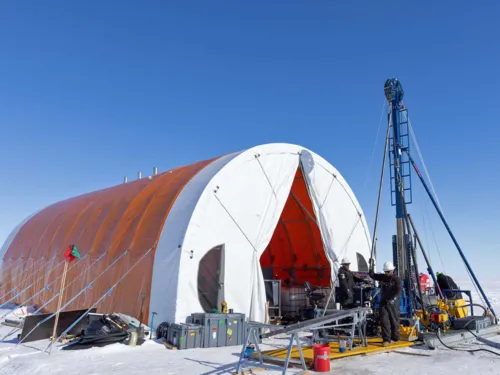
Drillers pull a core to the surface.
Satellite observations over the last few decades show that the West Antarctic Ice Sheet is losing mass at an ever-increasing rate. The ice sheet is supported on one side by the Ross Ice Shelf - the largest floating mass of ice in the world. This acts as a buttress and slows down the flow of glaciers and ice streams towards the ocean. However, it is unclear what global temperature rise will trigger an unstoppable melting of the ice shelf and thus the loss of the West Antarctic ice sheet.
Drilling mission directly at the transition between the ice shelf and the West Antarctic Ice Sheet
Until now, researchers have based their model calculations on the development of the ice sheet on geological data collected either in the vicinity of the ice sheet, under floating shelf or sea ice, in the open Ross Sea or in the Southern Ocean. The new sediment core was obtained as part of the SWAIS2C project (Sensitivity of the West Antarctic Ice Sheet to 2°C of Warming) under a 523-metre-thick layer of ice at the so-called Crary Ice Rise directly in the marginal transition area of the Ross Ice Shelf to the West Antarctic Ice Sheet.
"These records will give us important insights into how the West Antarctic Ice Sheet and Ross Ice Shelf will respond to temperatures above 2°C. Early indications suggest that the sedimentary layers span some 23 million years, including periods when the Earth's global average temperatures were well above 2°C compared to pre-industrial levels," says Huw Horgan, SWAIS2C co-principal investigator from Victoria University of Wellington (New Zealand) and ETH Zurich and WSL (Switzerland).
"We are thrilled to have finally obtained such a record core, which will give us extremely important insights into how the West Antarctic Ice Sheet in the Ross Sea sector reacted at times that were warmer and richer in CO2 than today," adds Dr. Johann Klages, German co-coordinator of the SWAIS2C project and geoscientist at the Alfred Wegener Institute. "Together with drill cores, which we plan to obtain next year with the research vessel Polarstern and a seafloor drill rig in the Amundsen Sea, these new and extremely difficult-to-obtain archives will hopefully be able to answer the question of when and under what conditions the West Antarctic Ice Sheet will disappear - in other words, key data to test and fundamentally improve the reliability of the latest climate models."
Dr. Andreas Läufer, German coordinator of the SWAIS2C project and geologist at the Federal Institute for Geosciences and Natural Resources, adds: "We have far exceeded our target of 200 m and that 700 km away from the nearest base - this is pioneering Antarctic science.
Major logistical and technical challenges for the research mission
The "On-Ice" team consisting of 29 people, including Dr. Arne Ulfers from the LIAG Institute for Applied Geophysics in Hannover, lived in tents on the ice for almost ten weeks of the season. Prior to this, the specially developed drilling system and field equipment had to be towed 1100 km across the Ross Ice Shelf using PistenBullys. The weather also posed a major challenge, as the flights of the drilling team and researchers to the camp were delayed by weeks due to ice fog in the camp.
In order to access the hard-to-reach sediment, the project team first had to use hot water to melt a hole through the 523-metre-thick ice. The core segments were then pulled out meter by meter. The researchers described, photographed and x-rayed the sections and took samples. Finally, measurements were taken in the borehole itself. The team worked around the clock in shifts.
"Research under extreme Antarctic conditions and at the limits of what is technically feasible is a particular challenge. It is therefore all the more gratifying that we have succeeded and that this important sediment archive can now be analyzed," explains Dr. Arne Ulfers. "The Intergovernmental Panel on Climate Change (IPCC) has predicted various climate scenarios for the coming century. It is crucial for the future that we continue to dedicate ourselves to the global task of complying with the Paris Climate Agreement and limiting global warming to two degrees Celsius or less."
Evidence of open ocean testifies to melted ice shelves
The researchers encountered a variety of different sediment types during their investigations, from fine-grained sediment to more solid material with embedded large stones. The preliminary dating of the sediments, which was carried out in the field, was based on the identification of tiny fossils of marine organisms found in some of the layers.
The presence of shell fragments and remains of marine organisms that require light to survive indicate open ocean conditions. "This new record confirms the assumption that there was an ice-free sea in this region in the past. Further study of the cores will help us determine when this happened and how long it lasted, as well as what conditions led to the melting of the ice," says co-principal investigator Molly Patterson of Binghamton University (United States).
Next steps: Analyzing sediments around the world
The core was first taken to the Scott research base in New Zealand and then transported on to New Zealand. "The first preliminary indications that there were ice-free phases in the past are extremely exciting and scientifically promising. Extensive further investigations are now necessary to understand the climatic conditions under which these were formed," explains Prof. Dr. Denise Kulhanek from Kiel University (CAU) and member of the SWAIS2C scientific leadership team. "We are currently planning a core description workshop in June, where we will open and describe the sediment cores in detail together with a core team of SWAIS2C researchers. This work is crucial to more accurately constrain the time frame and duration of earlier ice-free phases," Kulhanek continues. Samples will then be distributed to participating SWAIS2C scientists worldwide for further analysis.
Project SWAIS2C
The SWAIS2C project is a collaboration of researchers from ten countries - New Zealand, USA, Germany, Australia, Italy, Japan, Spain, Republic of Korea, the Netherlands and the United Kingdom - with more than 120 scientists. It is led by Molly Patterson (Binghamton University, USA), Richard Levy (Earth Sciences New Zealand and Te Herenga Waka - Victoria University of Wellington, New Zealand), Tina van de Flierdt (Imperial College London, UK) and Huw Horgan (Te Herenga Waka - Victoria University of Wellington, New Zealand, ETH Zurich and WSL, Switzerland). From Germany, researchers from the Federal Institute for Geosciences and Natural Resources (BGR, Hannover), the Alfred Wegener Institute Helmholtz Center for Polar and Marine Research (AWI, Bremerhaven), the LIAG Institute for Applied Geophysics (LIAG, Hannover) and the Christian-Albrechts-Universität zu Kiel (CAU, Kiel) are involved.
(Published: February 17, 2026)